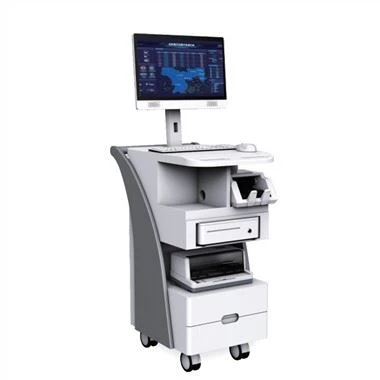
The following three most basic components constitute a touch screen system
(1) A touch screen for touch use. It is installed in front of the display screen to detect the user's touch position, and send the signal to the touch screen controller after receiving the signal. Touch screens are divided into four basic types according to their working principles and information transmission media: resistive technology touch screens, capacitive technology touch screens (including analog and near-field imaging projection capacitive touch screens), acoustic wave technology touch screens (including surface acoustic wave and acoustic bulk wave touch screens), Infrared scanning technology touch screen.
(2) —: A controller that can convert touch signals into control signals. The controller can be divided into RS-232 serial port, USB Pi, PS-Bus, PC/2, chipset controller and so on.
(3) —A set of driver software used to communicate between the controller and the operating system. The driver software uses the calibration points included in the program to convert the absolute coordinates transmitted by the touch screen controller into screen coordinates according to these calibration points. The driver also performs other operations required by related applications.
NT, CE, OS/2, Macintosh, Linux and other operating system drivers. Drivers for other systems can also be obtained from touch screen manufacturers.
Since the birth of touch screen, with its unique advantages and market effects, it has attracted the attention of many businesses: research on touch screens has sprung up all over the world, and new technologies continue to emerge. Some types of touch screens have now withdrawn from the stage of history due to their limitations or performance deficiencies, such as stress-type and vector pressure-type touch screens. There are four basic types of touch screen technologies that are currently widely used: surface acoustic wave technology touch screens, resistive technology touch screens (4, 5, 6, 8 lines), capacitive sensing technology touch screens (analog) and infrared scanning technology touch screens. Acoustic bulk wave technology touch screens and near-field imaging projection type capacitive screens also have a small number of applications in the market, and each type of touch screen has different characteristics and applications. In order to better adapt touch screen technology to the needs of users, it is important to understand the functions, principles and characteristics of each touch screen technology.
All eclipse touch screen systems are attached to the display, whether it is a CRT or a flat panel display. The biggest difference in touch screen technology is the method of detecting and processing data.